Recent Research Projects
Project Overview
Resilient Autonomic Software Systems (RASS)
 This project designed a framework called RASS inspired by the MAPE-K (i.e., Monitor, Analyze, Plan, and Execute based on Knowledge) paradigm for autonomic systems. Sensor data is obtained from a variety of systems by the Monitor component of RASS. These data are aggregated and sent to the Analyze Adaptation component that determines whether self-adaptation is needed and why. The results of this analysis are passed to the Plan Adaptation component, which determines an optimal or near-optimal plan to automatically adapt the system. This plan is received by the Execution Adaptation component, which sends adaptation commands to the parts of the system that need to be adapted and/or recovered, and orchestrates the adaptation to ensure an appropriate and consistent recovery. Because the adaptation plan is driven by the system’s software architecture, an Architecture Discovery module recovers the descriptive architecture (i.e., the one that reflects the actual system) or supplements the prescriptive architecture (i.e., the one used to guide the development) when one is not available or has been eroded by system evolution. The Knowledge Base of RASS includes recovery methods and models that capture their performance overhead, failure recovery software patterns, a configuration database, an application binary repository to assist in recovering the software architecture of mobile applications, and the descriptive and prescriptive software architectures. A significant challenge of our research was that all the activities described above need to be carried out in a distributed fashion without centralized control. This is essential to achieve high-resiliency and high-dependability.
- PI and Collaborators: Daniel A. Menasce, Hassan Gomaa, and Sam Malek
- Students: Jason Porter, Emad Albassam, Noor Bajunaid, Mahmoud Hammad
- Sponsors: Air Force Office of Scientific Research (AFOSR)
- Project Website: https://cs.gmu.edu/~menasce/rass/
- Selected Publications:
- N. Bajunaid and D.A. Menasce, Efficient Modeling and Optimizing of Checkpointing in Concurrent Component-Based Software Systems, J. Systems and Software, Vol. 139, May 2018, pp. 1-13.
- J. Porter, D.A. Menasce, H. Gomaa, and E. Albassam, TESS Automated Performance Evaluation of Self-Healing and Self-Adaptive Distributed Software Systems, 9th ACM/SPEC Intl. Conf. Performance Engineering (ICPE), Berlin, Germany, April 9--13, 2018
- E. Albassam, J. Porter, H. Gomaa, and D.A. Menasce, DARE A Distributed Adaptation and Failure Recovery Framework for Software Systems, 14th IEEE Intl. Conf. Autonomic Computing (ICAC 2017), Columbus, OH, July 17-21, 2017.
Self Architecting Software Systems (SASSY)
 The design of large-scale distributed software systems presents many challenges, including providing the means for the software to adapt to changes in the environment (e.g., workload changes and failures) and to evolve as a consequence of changes in the requirements. SASSY is a model-driven framework for run-time self-architecting and rearchitecting of distributed software systems. SASSY provides a uniform approach to automated composition, adaptation, and evolution of software systems. Our framework is inspired by the properties of one of the largest, most complex, highly dependable, and resilient systems ever designed - the Internet. Four important characteristics of the Internet design are responsible for its highly adaptive run-time behavior - i) autonomous organization as a collection of IP networks, ii) autonomic behavior including self-managing, self-configuring, self-optimizing, and self-healing properties afforded, for example, by its routing protocols and TCP’s congestion avoidance mechanism, c) distributed control as evidenced by its distributed routing decisions, and d) distributed run-time optimization through the implementation of distributed versions of centralized optimization algorithms, such as the shortest path algorithm for optimal routing. These characteristics of the Internet are not present in today’s large-scale real world software systems. SASSY represents a paradigm shift in architecting software systems that exhibit characteristics similar to the Internet. It provides mechanisms for self-architecting and re-architecting that determine the near-optimal architecture for satisfying functional and Quality of Service (QoS) requirements. The quality of a given architecture is expressed by a utility function provided by end-users and represents one or more desirable system objectives.
- PI and Collaborators: Daniel A. Menasce, Hassan Gomaa, Sam Malek, and Joao Souza
- Students: Naeem Esfahani, John Ewing, Mohamad Abu-Matar, Zeynep Zengin, Ehsan Kouroshfar, and Nariman Mirzaei
- Sponsors: National Science Foundation (NSF)
- Project Website: https://cs.gmu.edu/~menasce/sassy/
- Selected Publications:
- D.A. Menasce, H. Gomaa, S. Malek, and J.P. Sousa, SASSY A Framework for Self-Architecting Service-Oriented Systems, , IEEE Software, Vol. 28, No. 6, Nov./Dec. 2011.
- D.A. Menasce, J.P. Sousa, S. Malek, and H. Gomaa, QoS Architectural Patterns for Self-Architecting Software Systems, 7th IEEE Intl. Conf. Autonomic Computing and Communication, Washington, DC, June 7-11, 2010.
- D.A. Menasce, J. Ewing, H. Gomaa, S. Malek, and J.P. Sousa, A Framework for Utility-Based Service Oriented Design in SASSY, First Joint WOSP/SIPEW International Conference on Performance Engineering (WOSP/SIPEW 2010), San Jose, California, USA January 28-30, 2010.
Mason-Milli - 60 GHz Millimeter-wave Wireless Networking and Sensing
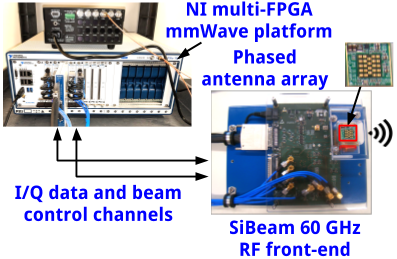 The major goal of this project is to design a state-of-the-art, programmable and reconfigurable 60 GHz millimeter-wave wireless networking infrastructure at George Mason University to enable millimeter-wave wireless networking and sensing research. Even as 60 GHz millimeter-wave wireless networking is gaining increasing attention from industry and research community, it has remained difficult to evaluate techniques and protocols on real testbeds. Our objective is to develop a testbed infrastructure that can be used by researchers to solve important outstanding problems in the field. Our aim is to design the 60 GHz infrastructure using software radios and commercial off-the-shelf devices. Mason-Milli consists of reconfigurable software radio nodes using National Instrument’s multi-FPGA platform integrated with SiBeam’s phased antenna array. It also includes a 60 GHz WLAN setup of 12 802.11ad devices that are capable of performing link layer as well as end-to-end experimentation and measurement studies.
- PI and Collaborators: Parth Pathak, Robert Simon, Brian Mark, Zhi Tian
- Students: Ding Zhang, Panneer Selvam Santhalingam
- Sponsors: National Science Foundation (NSF)
- Project Website: http://www.phpathak.com/mason-milli.html
- Selected Publications:
- Ding Zhang, Mihir Garude and Parth H. Pathak, “mmChoir - Exploiting Joint Transmissions for Reliable 60GHz mmWave WLANs”, ACM International Symposium on Mobile Ad Hoc Networking and Computing (MobiHoc), Los Angeles, USA, June 2018.
- Zhicheng Yang, Parth H. Pathak, Jianli Pan, Mo Sha and Prasant Mohapatra, “Sense and Deploy - Blockage-aware Deployment of Reliable 60 GHz mmWave WLANs”, IEEE International Conference on Mobile, Ad-hoc and Sensor Systems (MASS), Chengdu, China, Oct. 2018.
- Yue Wang, Zhi Tian, "Multiple Symbol Differential Detection for Noncoherent Communications with Large-scale Antenna Arrays", IEEE Wireless Communications Letters, April 2018.
Command and Control-Simulation Interoperability (C2SIM)
 Over the past ten years, a new approach has been developed to integrate coalition command and control (C2) systems and simulations into a complex system of systems. Teams from twelve NATO nations have worked together toward a vision that a coalition will be able to assemble such a complex system rapidly in a standards-based environment called Command and Control – Simulation Interoperation (C2SIM), with the result that each nation uses the national C2 system with which it has trained and that its forces are represented by a national simulation built around its capabilities and doctrine The resulting technology is being developed under auspices of the NATO Modelling and Simulation Group (NMSG) and standardized by the Simulation Interoperability Standards Organization (SISO) [2]. The GMU C4I and Cyber Center has been the technology leader in developing this capability. In a coalition environment, where each nation is likely to have different doctrine, equipment, and C2 information system (C2IS, also called C2 system), presents many challenges. The difficulty is even greater where the national forces in the coalition are capable of incorporating simulations to increase the functionality of their C2IS, resulting in improved functionality, timeliness, and cost savings. Simulations are useful as C2 system elements for course of action (COA) analysis and to stimulate training and mission rehearsal (including wargaming). Coalitions consist of military forces from multiple nations; generally, each national force has its own C2 and simulation systems, which complicates the problem of operating as a cohesive whole. The goal of C2SIM is to enable an environment where national C2 systems can exchange information freely and each nation’s military operations can be represented accurately, with each nation’s force representing their own military operations by means of their own simulations. In developing C2SIM technology and standards, we look forward to a day when a newly-formed coalition, operating over a shared network, can “plug in” their C2 and simulation systems to the network and work together rapidly and seamlessly to train, analyze COAs, and perform mission rehearsal. As a result, the coalition will able to perform these functions as a cohesive whole and do so more rapidly and efficiently.
- PI and Collaborators: J. Mark Pullen and Michael Hieb
- Students: Nicholas Clark
- Sponsors: US Army Modeling and Simulation Office (AMSO)
- Project Website: https://c4i.gmu.edu/battle-management-language/
- Selected Publications:
- https://netlab.gmu.edu/pubs/index.html#netsim
Reliable 60 GHz WLANs through Coordination - Measurement, Modeling and Optimization
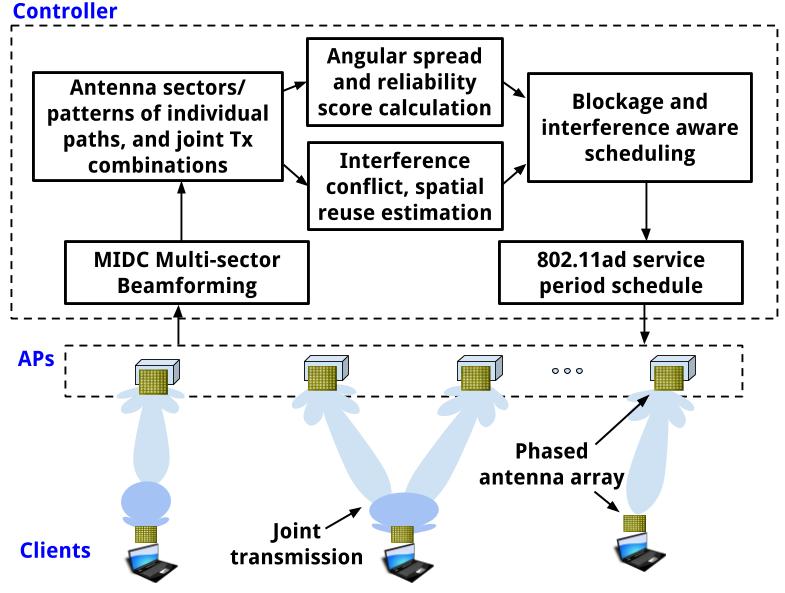 Although wireless networks have advanced significantly over the last few years, newly emerging applications such as augmented/virtual reality and ultra high-definition video streaming and the continuous growth of mobile and wearable devices are leading to higher than ever mobile traffic demand. Wireless communication using the 60 GHz unlicensed millimeter-wave spectrum has shown the potential to bridge this gap by providing multi-gigabit per second data rates. Designing enterprise-grade 60 GHz millimeter-wave wireless networks is challenging due to directionality and severe performance degradations observed in presence of human blockages. The aim of this project is to investigate a novel class of proactive blockage mitigation techniques based on coordination between the access points of 60 GHz WLANs. The proposed research exploits joint transmissions from multiple access points to mobile devices. With intelligent selection of access points and antenna sectors, such joint transmissions can provide adequate spatial diversity and separation of angle-of-arrival, resulting in robust communication in presence of self-body blockages. The project will use measurements, modeling and optimization to design, analyze and evaluate joint transmissions.
- PI and Collaborators: Parth Pathak, Zizhan Zheng
- Students: Yoon Chae, Ding Zhang
- Sponsors: National Science Foundation (NSF)
- Selected Publications:
- Ding Zhang, Mihir Garude and Parth H. Pathak, “mmChoir - Exploiting Joint Transmissions for Reliable 60GHz mmWave WLANs”, ACM International Symposium on Mobile Ad Hoc Networking and Computing (MobiHoc), Los Angeles, USA, June 2018.
- Zhicheng Yang, Parth H. Pathak, Jianli Pan, Mo Sha and Prasant Mohapatra, “Sense and Deploy - Blockage-aware Deployment of Reliable 60 GHz mmWave WLANs”, IEEE International Conference on Mobile, Ad-hoc and Sensor Systems (MASS), Chengdu, China, Oct. 2018.
- Zhicheng Yang, Parth H. Pathak, Yunze Zeng and Prasant Mohapatra, “Sensor-assisted Codebook-based Beamforming for Mobility Management in 60 GHz WLANs”, IEEE International Conference on Mobile Ad hoc and Sensor Systems (MASS), Dallas, TX, USA, October 2015.
XD3
The GMU XD3 project called SR2 (for Shuffle, Redirect, Replicate) elevates continuous system evolution and dispursion of available resources as first-rate design principles. We enable an environment for network services that constantly changes along several dimensions which creates an unpredictable target for a Denial of Service (DoS) adversary. This unpredictability impedes the adversary’s ability to focus his attack to specific “pinch” points in the end-to-end network connectivity or otherwise corrupt specific elements of the system to disrupt or otherwise impede the ability of clients to connect to network services.
- PI and Collaborators: Angelos Stavrou
- Students: Guanhua Liu
- Sponsors: DARPA
- Project Website: https://www.darpa.mil/program/extreme-ddos-defense
- Selected Publications:
- George Kesidis, Yuquan Shan, Neda Nasiriani, Takis Konstantopoulos, Daniel Fleck and Angelos Stavrou, "Moving-target Defense against Botnet Reconnaissance and an Adversarial Coupon-Collection Model", IEEE Conference on Dependable and Secure Computing (DSC 2018).
- Yuquan Shan, George Kesidis, Dan Fleck, Angelos Stavrou, "Preliminary Study of Fission Defenses Against Low-Volume DoS Attacks on Proxied Multiserver Systems", Malware Conference (MALCON 2017).
- Yuquan Shan, George Kesidis, Dan Fleck, "Numerical Evaluation of Cloud-Side Shuffling Defenses against DDoS Attacks on Proxied Multiserver Systems", 9th ACM Cloud Computing Security Workshop (CCSW 2017).
City and County Cybersecurity Partnership Project
The Cybersecurity City and County Cross Jurisdictional Collaboration project is aimed at furthering U.S. city and county cybersecurity efforts by developing foundations and policies that enable and foster city and county cybersecurity partnerships. The motivation for the project is that many U.S. cities and counties have relatively limited budgets and expertise to address the major and rapidly changing cybersecurity threat. In addition, many cities and counties are increasingly adopting connected technology not just for administration but also for critical infrastructure such as electric, water and transportation systems. Through partnering with other cities and counties in areas such as cybersecurity governance, staffing, procurement, leadership, training and information sharing, cities and counties are better able to address their cybersecurity needs.
- PI and Collaborators: J.P. Auffret, Angelos Stavrou
- Students: None
- Sponsors: National Science Foundation (NSF)
- Project Website: https://care.gmu.edu/city-county-cybersecurity-partnership-project/
- Selected Publications:
- J.P. Auffret, Angelos Stavrou, Peng Warweg, "Richmond City and County Cybersecurity Partnerships Workshop Report - Review, Recommendations and Resulting Initiatives" 2017
- Personal Cybersecurity Advice from a Local Government CISO. David Jordan, J.P. Auffret, Angelos Stavrou, Peng Warweg (2018)
- Local Government Cybersecurity Policy Templates – Virginia Series. David Jordan, J.P. Auffret, Angelos Stavrou, Peng Warweg (2018)